Women make up almost half of the world, yet their lived reality often doesn’t reflect that balance. Whether at home, at work, or in leadership, the gap between men and women is still visible everywhere.
A big part of this inequality begins at home. Even today, women shoulder most of the household and caregiving responsibilities. This sets the tone early—when one gender is doing more unpaid work, they naturally get fewer chances to focus on their careers or personal growth. Safety is another huge concern. From online abuse to real-world violence, many women grow up constantly calculating risks that men rarely think about.
The professional world isn’t much different. Women are still underrepresented in managerial roles, boardrooms, and senior leadership positions. And at the very top—CEO roles, major national positions, and key institutions—women are still rarely seen. Across several industries like construction, logistics, and heavy engineering, the gender gap is even wider.
In India, the story mirrors the world. More girls are entering fields like engineering and law, and literacy rates have improved, but women’s workforce participation is still low. Many women work in informal or unpaid roles, and leadership opportunities are limited. Several prominent national positions—like heads of major institutions or defence roles—have never been held by a woman even once.
But inequality isn’t only about external barriers. Internal barriers—shaped by society—hold women back too. As Sheryl Sandberg puts it, many women “leave before they leave,” meaning they step back from opportunities because they expect future responsibilities to come in the way. Add to this the pressure to be perfect at home, perfect at work, and perfect as a mother, and it becomes clear why many women hesitate to aim higher.
Recently I watched a movie “6888” on Netflix. The 6888th Postal Directory Battalion during World War II—an all-Black women’s unit that cleared a massive backlog of mail for the US soldiers in Europe. They worked under pressure, faced prejudice, and still delivered what everyone else thought was impossible.
The message is simple: women are not lacking in capability—the world is lacking in acceptance.
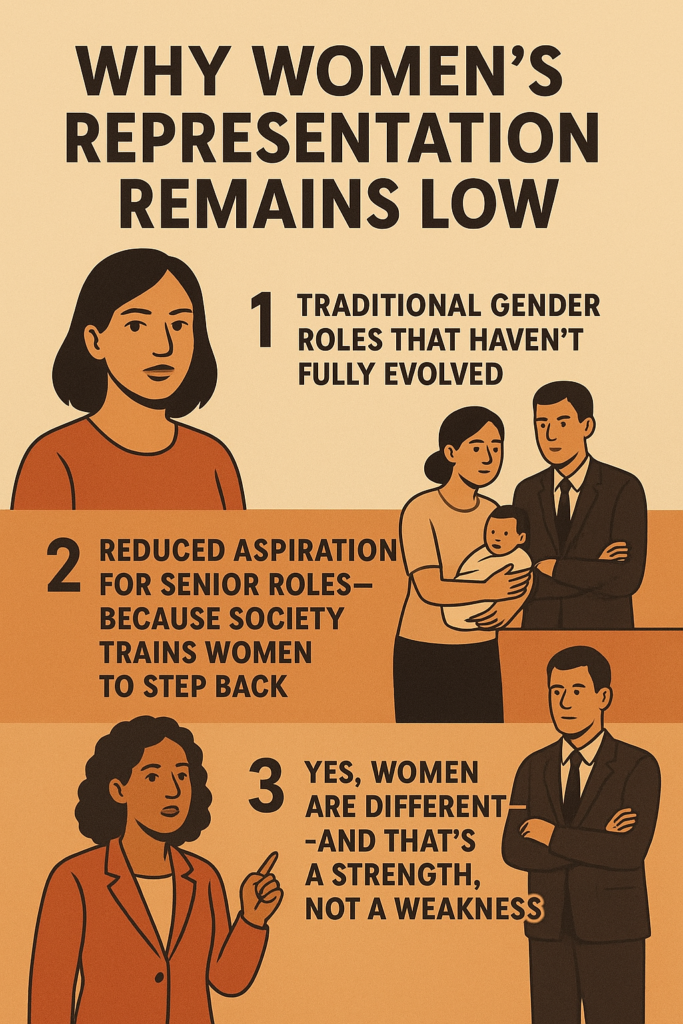
Why Women’s Representation Remains Low???
1. Gender Roles That Haven’t Fully Evolved
Even today, many households still expect men to be the earners and women to be the caretakers. And although this should be a personal choice, many women end up leaving work after childbirth because they feel emotionally responsible for managing everything at home. This isn’t about capability—it’s about conditioning.
2. Too Little Aspiration for Senior Roles—Because Society Trains Women to Step Back
Across industries, men dominate the top roles. Part of this is because men are encouraged from early on to compete and strive, while women are taught to “balance,” “adjust,” and “not be too ambitious.”
I remember my mother always reminding me: if you don’t take care of your health and happiness, nothing else will fall into place. When women genuinely enjoy their work and feel supported, they thrive. Participating in decisions, expressing ambition, and showing leadership potential are crucial steps—not just for career growth but for shaping how workplaces see women overall.
3. Yes, Women Are Different—And That’s an Advantage, Not a Weakness
The core idea of equality is simple: equal opportunities, not identical personalities. Women often bring empathy, patience, and emotional intelligence—qualities every good leader needs. But in male-dominated spaces, some women feel pressured to hide these traits just to “fit in.” This shouldn’t be necessary.
Men must consciously make space for women colleagues, and value different leadership styles instead of expecting everyone to behave the same.
Qualities like integrity, commitment, and vision aren’t tied to gender—they belong to anyone willing to lead.
Conclusion
If the same people with the same perspectives keep making decisions, nothing will ever change. Workplaces need to open up and welcome women not just as employees but as leaders.
At the same time, women who do have the opportunity to work carry a responsibility—both to themselves and to future generations. They stand on the shoulders of women who fought for even the basics, like education or a job. Today’s women have the chance to push the boundary a little further.
Yes, women often juggle more—home, work, childcare, and social expectations—but they also have more role models today than ever before. The path is still challenging, but it’s no longer impossible.
Women need to be confident, competitive, and unapologetically ambitious. And society needs to meet them halfway—with acceptance, respect, and a willingness to change.
Only then can the world reflect what the numbers already tell us: women aren’t half the problem—they’re half the solution.